Community Research Initiative


Sep 2016 to present.
Why do research?
- To set out “What is to be done / What is doable?”
- What is our vision of the future that we want to see — and how
do they fit together - What actions do we want take
- Why Art / Earth / Tech
- What is our vision of the future that we want to see — and how
- Create policies and recommendations e.g. in governance, in politics,
in technology - Answer specific questions we have - without it coming under a bigger
theme - Have a shared understanding within Art / Earth / Tech
- To do collaborative research and get experience of doing them
without the normal incentive structures - Answer practical questions e.g. what practical challenges are there to doing what we would like or what business model could we have?
- This would likely come under other activities e.g. the working
group looking at material sustainability would research
business models
- This would likely come under other activities e.g. the working
Criteria
- Relate to why we do this
- Interesting to those who are going to contribute …
- Not too hard
- Will not take years to get anywhere
- we may do big multi-year research at some point however
probably would do that in its own working group - Will not require very deep specialist knowledge (e.g.
quantum physics)
- we may do big multi-year research at some point however
- Will not take years to get anywhere
- Accessible - others can join in, others outside of Art / Earth /
Tech could be interested - Replicable - others can follow our findings and “repeat” them in
appropriate manner
Guidelines for Primers
- What are we trying to achieve with the primer items? Ans: Have a shared understanding within AET group and community
- No need for originality - we can copy and paste from wikipedia!
- They can be opinionated
- Establish common ground
- Audience
- Who is going to read it? AET community and the research group.
- What prior knowledge is expected
- Of the broader AET research effort: non especially
- May be useful to understand these are part of AET
research effort but not essential - Of the specific topic: can vary. Usually assume very little.
On technical topics is fine to state pre-requisites e.g.
please go and read this and this
- Length: 1-5 pages.
- 1 page is great! 1 page exec summary if more than 2 pages.
- + further reading / references
- Style: friendly, succinct, informative, not too academic.
Primers
- Memes Primer (2016)
- Mindfulness Primer (2016)
- Non-attachment to Views Primer (2016)
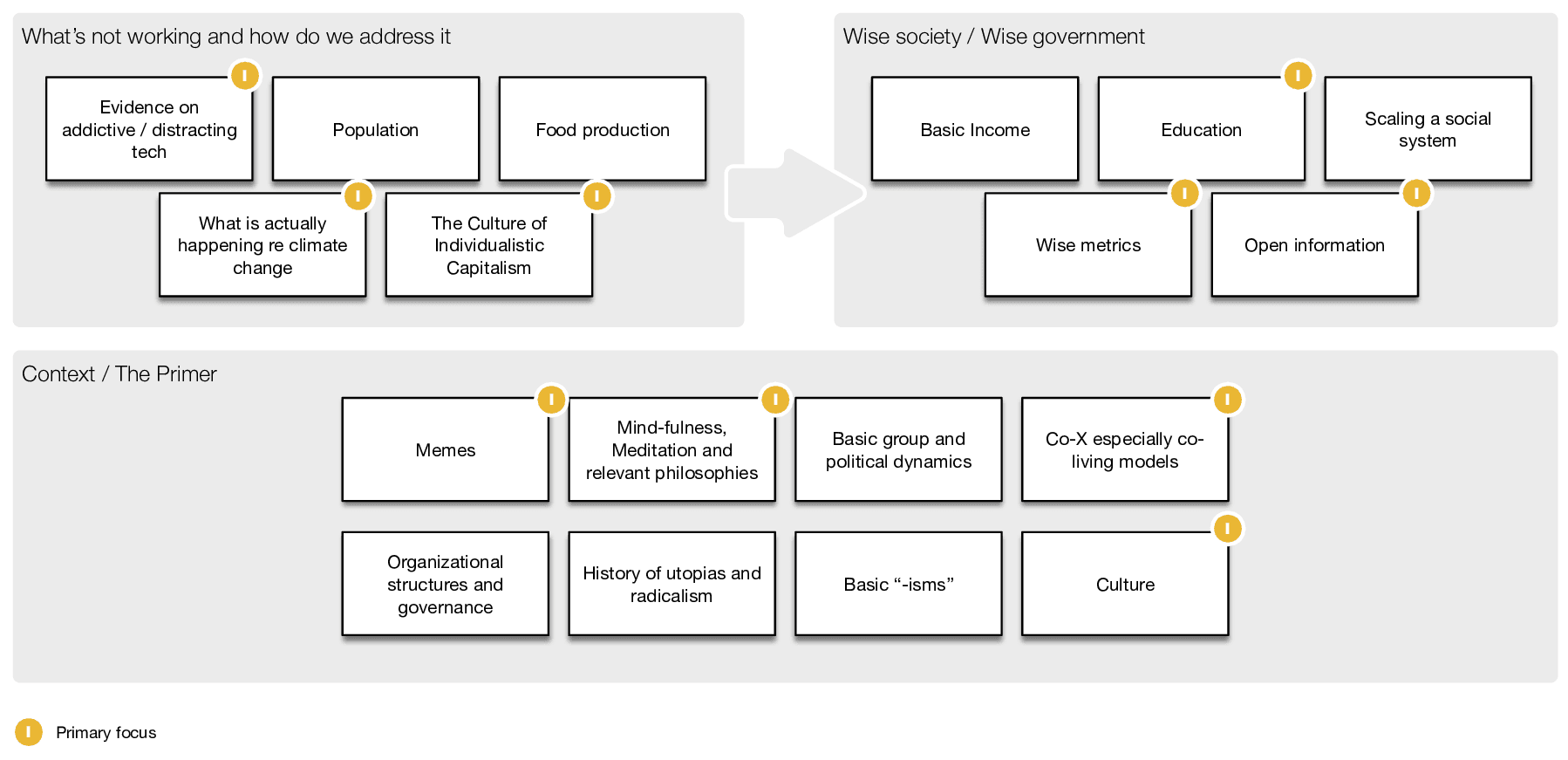
1, 2, 3, 5, 8, 13 for voting on cost and value () = cost {} = value
Longlist
- Wise society / Wise government - AET’s Own Policy Program
- Basic Income (2) {3.3}
- **Education. Where has a great educational system? What do we know about good education? (3.6) {7.6}
- Wise metrics. Build a dashboard showing performance of countries or areas on our wise metrics (e.g. wisest city in the US, wisest country in the world). Pick metrics, collect data, build a dashboard. (6) {8.6}**
- Reason from Stefan: in long run not that important, but in short run very important.
- Scaling a social system such as a corporation, organization or a community. What is optimal size. Often think scaling is about making one thing bigger. But maybe about point where you split. (5.3) {3.6}
- Connection: org structures
- Open information - openness as the economic policy question and solution of the information age. How much do we spend on IT a year in gov and generally. How much on content? How could we fund this differently? And what would be the numbers. (2.3) {7.6}
- What’s not working and how do we address it- specific examples (more granular than wise society and connected with it)
- Evidence on addictive / distracting tech (and best ways to address) e.g. TV, facebook etc (3.3) {8} (Liam)
- Population. How many people can the earth support? How many should we aim for as a global population? (5) {3.3}
- Reading list: Joel Cohen, Vaclav Smil
- What is actually happening re climate change. What is situation with CO2 and what warming has happened. Examples of impact already / very likely to happen. (4.3) {4}
- What actions should we take on climate change. What is a plausible renewable energy policy for the world
- Food production. Intensive vs organic etc. What are alternative ways of producing foods vs intensive agriculture - how efficient are they. What are the benefits? (4.5) {4.3}
- The Culture of Individualistic Capitalism. Impact on people of consumerism, competition, individualism, inequality. (5) {8.6}
- Daniel Bell: cultural contradictions of capitalism
- Context / the Primer - material people who joined Art / Earth / Tech would read, explanation of why this is related to AET’s work
- Non-attachment to views and how and why people change their minds
- Discrimination and Universalism: racism, sexism and their opposites (Sylvie). What is so? Where does it arise
- Link to group dynamics
- Creation and Creative process. Meaning, purpose and alignment.
- Wellness …. (individually and socially. vs growth etc)
- Wisdom - reuse liam’s reflections from gathering (?)
- Memes. What is a meme? Why are they important for our work (1.3) {8} (Stefan)
- Mind-fulness, Meditation and relevant philosophies e.g. Daoism, Buddhism (1.6) {11.3} (Rufus + (Liam))
- Basic group and political dynamics. Collective action problems. Prisoner Dilemma. Principal agent problem. Robustness against defectors. Folk theorem. Sorting. (1.6) {5.3}
- Reading list: John Holland: Hidden Order, Robert Axelrod: Evolution of Cooperation. Schelling?
- Co-X especially co-living models. What are cooperatives etc. Good examples of the above. (1.3) {7}
- Cooperation outwardly - not just inwardly
- Organizational structures and governance esp “novel” ones - non-hierarchical or decentralized orgs etc … Get case studies. (3.3) {6}
- Laloux - Reinventing Organizations, Semler,
- Connection: culture, co-x etc, scaling
- Culture - what is it, what are good examples of great and very poor cultures (community, corporate or otherwise), how do you create and instil culture? (4.3) {9.6}
- Cooperation and non-hierarchy
- No asshole rule - costs
- History of utopias and radicalism. - Histories of attempts to change society. (5) {8}
- Connections: Co-X, isms, Collective action problems
- Basic isms: Capitalism, Socialism, Anarchism, … (2.6) {2.3}
Reading Group - to discuss